It's the water heater (or the corner it sits in)
Why did the plumber say we need an expansion tank?
Answered by the column’s editors · · about 5 minutes to read
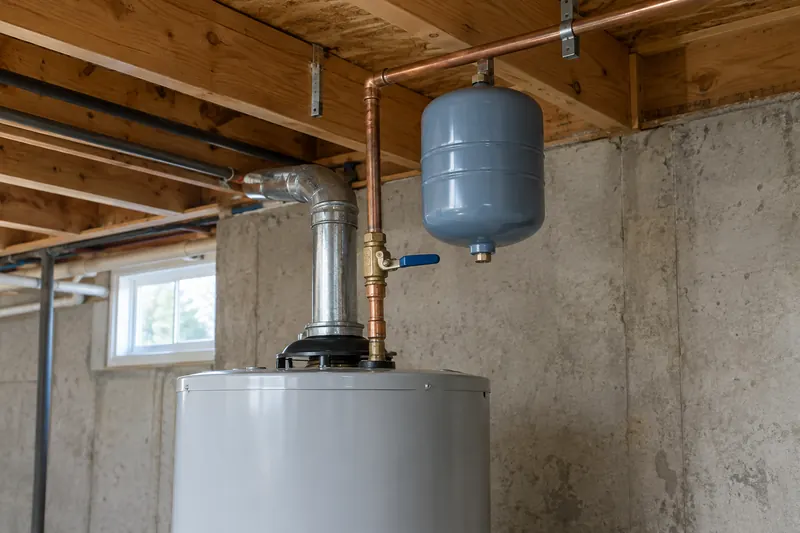
A water heater expansion tank gives heated water room to grow. When a check valve, backflow preventer or pressure-reducing valve stops water flowing back to the street, the code calls for expansion control, usually a tank.
Water grows a little when you heat it. In an older house, that extra volume simply nudged back out through the service line toward the water main, and nobody noticed. Add a one-way device at the meter or on the main line, and that escape route closes.
Now each time the heater runs, the expanding water has nowhere to go, so house pressure climbs. The small tank your plumber suggested soaks up that surge.
What does "closed system" mean?
It means water can flow into the house but can't flow back out toward the street. Three common parts create that one-way setup: a check valve, a backflow preventer, or a pressure-reducing valve (PRV).
The model plumbing code addresses both cases. Where a backflow preventer or check valve lets thermal expansion raise pressure, a device for controlling pressure has to be installed. The same applies when expansion pushes pressure on the house side of a PRV above the valve's setting. WSSC Water adopts that model code by reference and doesn't rewrite the thermal expansion section, though we couldn't read the 2024 wording directly.
Why would a Maryland house suddenly be "closed"?
Often because of work done for some other reason. Under the 2024 WSSC code, a homeowner who pulls their own permit has to have containment backflow protection, and if the house has none, they must install an ASSE 1024 dual check. A dual check is a one-way valve, so it creates exactly the closed system described above.
PRVs are the other route. WSSC's code makes the property owner or design team responsible for deciding whether a PRV is needed to keep house pressure at 80 psi or less. Once a PRV is in, expansion control usually follows.
What happens if a closed system has no expansion tank?
The pressure has to go somewhere, and the weakest point takes it. A.O. Smith's manual warns that thermal expansion can cause premature tank failure, meaning a leak, and can make the relief valve drip. Neither problem is covered by that maker's warranty.
The same manual says the T&P relief valve isn't meant to relieve thermal expansion over and over; a closed system needs a properly sized expansion tank instead. So a relief valve that weeps a little after every long shower is a classic sign. If yours has already started leaking at the base, see what a water heater leaking from the bottom usually means.
How does the tank work?
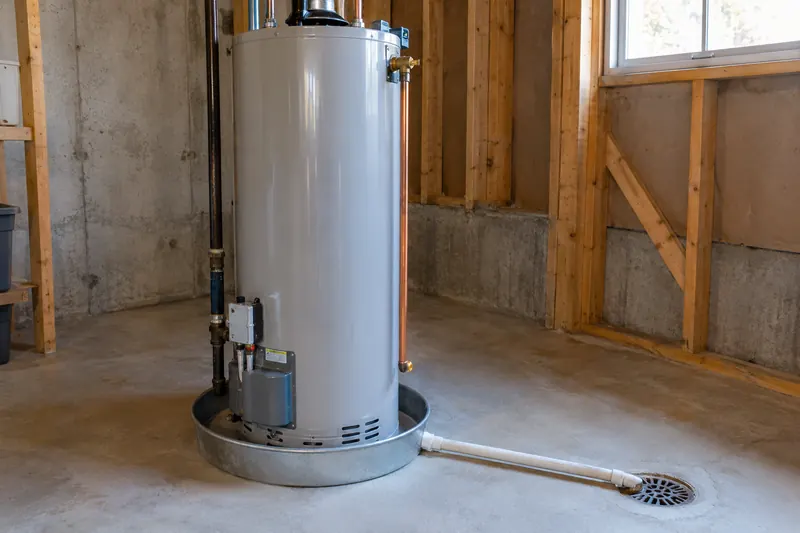
Inside the tank, a flexible diaphragm separates water from a cushion of compressed air. When heated water expands, it pushes into the tank and squeezes that air. When you open a tap, the air pushes the water back out. The house pressure stays steadier and the relief valve stays shut, discharging into its pipe (and, in many basements, a drain pan) only when something is truly wrong.
How is it sized and set up?
The details come from the tank's maker, not a rule of thumb. Amtrol's instructions say to set the air pre-charge to match the cold water supply pressure while the tank is empty, and to mount it on the cold line between the water heater and the check valve, backflow preventer or PRV. A tank left at its factory pre-charge in a house running at a different pressure won't do its job well.
The same manual says the product must be installed by a licensed professional, and recommends a yearly check of the tank and system.
| Part | Where you'd usually find it | Why it matters here |
|---|---|---|
| Check valve | Near the meter or main shutoff | Stops water flowing back to the street |
| Dual check backflow preventer | On the main line after the meter | One-way by design; required for WSSC homeowner permits if none exists |
| Pressure-reducing valve | Just inside the main shutoff | Lowers incoming pressure; expansion can push house pressure above its setting |
Who should install it, and does it need a permit?
A licensed plumber, per the maker. Whether your particular job needs a permit depends on who issues permits where you live; this guide to WSSC and county permit offices sorts that out. If the tank goes in with a new heater, remember that in WSSC territory a gas water heater replacement needs a licensed plumber, a permit and an inspection, while an electric swap with no concealed piping changes is exempt.
Ask the plumber what makes the system closed, what pressure they measured and what pre-charge they set.
The bottom line
If something in your water line keeps water from flowing back out, heated water needs a place to expand, and the code expects pressure control. An expansion tank set to your house pressure protects the heater and keeps the relief valve from doing a job it wasn't built for. Have a licensed plumber fit it and check it once a year.
Readers also ask
Can an expansion tank go bad?
Yes. The diaphragm can fail or the air charge can leak away, and then the tank fills with water and stops absorbing anything. That's why Amtrol suggests a yearly check.
Does a tankless water heater need an expansion tank?
Ask the heater's maker and your plumber. The model code's trigger is a closed system where thermal expansion raises pressure, so the answer depends on your setup.
Where does the expansion tank go?
Amtrol says on the cold water line between the heater and the check valve, backflow preventer or PRV.
Is a dripping relief valve always an expansion problem?
No, but it's a common one. A licensed contractor should inspect a relief valve whenever it has discharged, and at least every 3 years, according to Amtrol.
Will the tank fix high water pressure from the street?
No. A tank absorbs expansion from heating. High incoming pressure is a PRV question, and WSSC's code puts that decision on the owner.