It's the water heater (or the corner it sits in)
Does our basement water heater need a drain pan?
Answered by the column’s editors · · about 5 minutes to read
A water heater drain pan isn't required by code in a WSSC-area basement, but it's still a good idea. Outside Montgomery and Prince George's, check your county, because the model code asks for one wherever a leak would do damage.
Here's the thing about tank water heaters: they don't last forever, and the way they usually die is by leaking. A.O. Smith's own instruction manual puts it bluntly, saying all water heaters eventually leak, which is why the maker wants drainage planned around every tank.
So the real question isn't whether yours will leak someday. It's whether the water will have somewhere harmless to go, and whether anyone notices in time.
Does the code require a drain pan in a basement?
In Montgomery and Prince George's counties, no. The WSSC Water code in force since December 2025 amends the pan rule so it applies only to heaters installed above living space or above the lowest habitable level. The amendment says outright that pans are not required in basements, finished or unfinished.
Elsewhere the answer depends on your county. The model plumbing code asks for a pan under a storage tank heater anywhere a leak from the tank will cause damage. Baltimore, Howard, Anne Arundel and Frederick counties each run their own permit offices, so ask yours how it reads that rule for a basement. Not sure who that is? Start with who issues plumbing permits where you live.
Why put one in if it isn't required?
Because "not required" isn't the same as "not useful." A finished basement with carpet, drywall and storage boxes is exactly the kind of place where a slow drip goes unnoticed for weeks. Amtrol's expansion tank manual goes further than the WSSC code, saying a drip pan must be installed where leaks could cause damage.
A pan buys you time. It catches a small leak, steers it to a drain, and keeps it off the floor long enough for someone to spot the wet spot. The EPA's mold guidance is to dry wet materials within 24 to 48 hours, and a pan makes that window much easier to hit. If a leak already got past you, read how fast mold starts after a basement leak.
What makes a pan actually work?
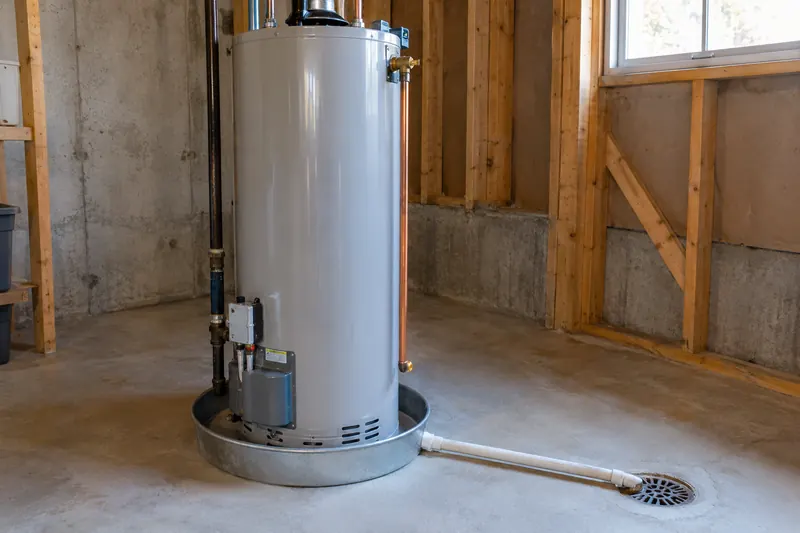
A pan with no drain is just a shallow bucket. Where the model code calls for one, it should be at least 1-1/2 inches deep and drained by a pipe at least 3/4 inch across. That pipe runs full size to a floor drain or other indirect waste receptor, or outdoors, ending 6 to 24 inches above the ground.
Material matters under a gas heater. WSSC's code says a plastic pan beneath a gas-fired unit needs a flame spread index of 25 or less, which rules out most bargain plastic trays.
| Setup | What happens when the tank leaks |
|---|---|
| No pan | Water spreads across the floor and into anything porous nearby |
| Pan, no drain line | Catches a drip, then overflows once it fills |
| Pan piped to a floor drain | Leak goes down the drain; you may not notice it for a while |
| Pan piped to a drain, plus a leak alarm | Leak drains away and something beeps to tell you |
Can the relief valve pipe drain into the pan?
Yes, and in many basements it does. That copper or plastic pipe running down the side of the heater is the discharge line from the temperature and pressure (T&P) relief valve. The model code says it must be at least as large as the valve outlet, drain by gravity, have no valves or tees and no threaded end, and stop no more than 6 inches above the floor or the receptor, where someone can see it.
Ending it over the pan is fine. Capping it, plugging it or shortening it to stop a drip is not. If it drips, the valve is telling you something, often about pressure, which is the subject of why plumbers recommend expansion tanks.
Who can put a pan under an existing heater?
Sliding a pan under a heater that's already installed means draining it and lifting or disconnecting it. In WSSC territory, electric heater swaps skip the permit, provided nobody reroutes pipes inside the walls, but any gas water heater work needs a WSSC-licensed plumber or gasfitter, a permit and an inspection. Frederick County requires a permit and inspections for gas appliances. In practice, most people add the pan the next time the heater is replaced, when the tank is out anyway.
The bottom line
In Montgomery and Prince George's basements, the code doesn't make you have a pan, but a drained pan is cheap insurance against the leak every tank eventually develops. Elsewhere, ask your county. Either way, leave the relief valve pipe open and ending where you can see it.
Readers also ask
Should a drain pan be metal or plastic?
Under an electric heater, either can work. Under a gas heater in the WSSC area, a plastic pan has to meet a flame spread index of 25 or less, so metal is the simpler choice.
Does a pan need its own drain line?
It should have one. A pan without a drain only catches a small drip before it overflows; the model code calls for a 3/4-inch drain to a receptor or outdoors.
Can the pan drain into the sump pit?
Ask your permit office first. The model code points pan drains to an indirect waste receptor, a floor drain or outdoors, so the safe default is a nearby floor drain.
Is a water leak alarm a substitute for a pan?
Not really. An alarm tells you water is there; a drained pan keeps it off the floor. Together they work better than either one alone.
Where this answer comes from
- WSSC Water: plumbing code with the basement pan exemption (archived copy)
- International Code Council: 2012 International Plumbing Code
- ICC: International Residential Code, 2012 edition
- U.S. DOE Building America: tank versus tankless heater life
- A.O. Smith: Water heater instruction manual 100293647
- AMTROL: Therm-X-Trol installation and operation manual
- U.S. EPA: drying times to prevent mold
- Frederick County: Notice about replacements (archived copy)