How long should a sump pump last, and when do we replace it?
Answered by the column’s editors · · about 5 minutes to read
How long sump pumps last has no honest single answer: it depends on the pump, how hard it works and how it was installed. Replace yours when it fails a test or shows failure signs, not on a birthday.
Here's the thing about sump pump lifespans: the companies that build them won't commit to a number either. Liberty Pumps says only that a properly installed pump can give many years of reliable service (Liberty Pumps FAQ). An older University of Illinois Extension guide leaned the other way and said a pump typically has to be replaced every few years (Illinois Extension, archived copy).
The spread makes sense: a pump that kicks on a few times each spring lives a very different life from one that cycles all summer over a high water table. So instead of counting years, watch how the pump behaves and test it on a schedule.
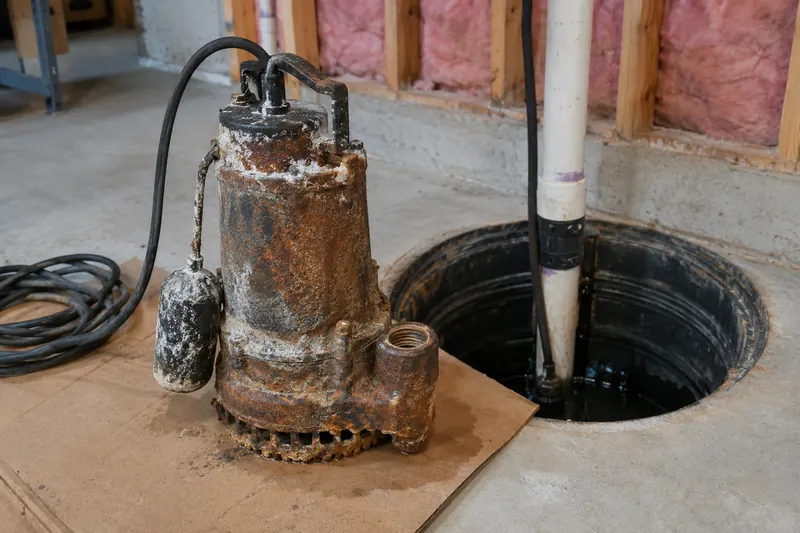
How long do sump pumps last when they work hard?
Every start wears the switch and motor, so anything that adds starts shortens the pump's life. Illinois Extension warns that a pump too powerful for its pit will short-cycle and can fail early.
Liberty lists three reasons a pump short-cycles: a badly adjusted float switch, a basin that's too small, or more water coming in than expected. If yours clicks on every few minutes in dry weather, read why a sump pump runs constantly before you decide it's worn out.
Pit size matters too. The model plumbing code calls for a pit at least 18 inches across and 24 inches deep (International Code Council, 2012 IPC); a smaller one fills faster and means more starts per storm.
What are the signs a sump pump is failing?
| Sign | Likely cause | What to do |
|---|---|---|
| Won't start when the pit fills | Jammed or failed float switch, or no power | Make sure the float moves freely and nothing is snagged on it; if it's free and the pump still won't start, the switch or pump needs replacing |
| Runs and won't shut off | Stuck float, failed check valve, or heavy inflow | Clear the float; watch whether water rushes back into the pit when the pump stops |
| Motor runs but nothing comes out outside | A check valve stuck shut, a clogged line, or an impeller that has come loose | Have the valve and discharge line checked; a loose impeller usually means a new pump |
| Starts and stops every minute or two | Float set wrong, basin too small, or heavy inflow | Adjust the float, or have the pump and pit sized properly |
Liberty names the first two as signs of a failed float switch and says to check the float for debris first (Liberty Pumps FAQ).
How do we test a sump pump?
Illinois Extension's method: pour enough water into the basin to lift the float, then confirm water is flowing out of the discharge pipe outside. Do it before the wet season and after long dry spells.
A five-minute sump pump test
- Lift the lid and check that the float has room to move and nothing is caught on it.
- Pour a bucket of water slowly into the pit until the float rises.
- Listen for the pump to start promptly, and watch the level drop.
- Go outside and confirm water is leaving the discharge pipe, not pooling against the foundation.
- Watch the pump shut off, and check that water doesn't flow back into the pit.
Step five tests the check valve, which keeps pumped water from draining back into the basin after the pump stops.
In Montgomery and Prince George's, WSSC's code lists foundation sump pumps among illegal discharges into the sanitary sewer in §116.4 (WSSC Water, 2024 Plumbing and Fuel Gas Code, archived copy). See the rules on where the discharge may go.
When should we replace the pump rather than fix it?
A clean float and a clear discharge line revive a surprising number of "dead" pumps. Replace the pump when it still fails the bucket test after those checks, or when the motor runs but moves no water through a clear pipe. If you're finishing the basement and nobody knows the pump's age, swap it before the drywall goes up.
Size the new one by flow, not horsepower, using the maker's curve of gallons per minute at each height of lift (Illinois Extension). Here's what size sump pump you need. Illinois Extension also says a sump pump needs its own dedicated circuit, which is an electrician's call.
How often does a backup pump battery need replacing?
Liberty says most backup batteries last 3 to 5 years (Liberty Pumps FAQ), and Zoeller's AquaNot Spin manual says to replace the battery every 3 years (Zoeller installation instructions). Write the install date on the case.
Liberty's 442 manual says a dead battery needs at least 12 hours to recover (Liberty 442-Series manual), so a second storm the next day may find it half full. More on that in whether a battery backup is worth it.
The bottom line
No sump pump comes with an expiration date. Test it with a bucket before each wet season, learn the failure signs, and replace it when it stops passing. Batteries are the exception: plan on a new one every 3 to 5 years.
Readers also ask
Can we just replace the float switch?
Often, yes, but check the float for debris first, since a jammed float mimics a failed switch.
Should we replace the backup battery when we replace the pump?
Only if it's near the end of its own 3 to 5 year life. Date both.
How often should we test the pump?
Before the wet season, after long dry spells and after any power outage.
Does insurance pay if an old pump fails and the basement floods?
The Maryland Insurance Administration says sump overflow damage is covered only with the optional back-up endorsement on your policy. More in our insurance answer.
Do we need a permit to replace a sump pump?
WSSC leaves sumps to the county building official, so ask your county. New wiring is an electrician's job.
Where this answer comes from
- Liberty Pumps: pump FAQs, page 31
- Illinois Extension guide on sump pump sizing (archived copy)
- Liberty Pumps: float switch FAQs, page 5
- ICC: 2012 IPC text, Public.Resource.Org copy
- Zoeller: AquaNot Spin backup pump instructions, FM3166
- WSSC Water's current plumbing code, effective December 2025 (archived copy)
- Liberty Pumps: backup battery FAQs, page 1
- Zoeller: AquaNot maintenance-free batteries, FM3303
- Liberty Pumps: StormCell 442 manual
- Maryland Insurance Administration (archived copy): what counts as flood or water damage